
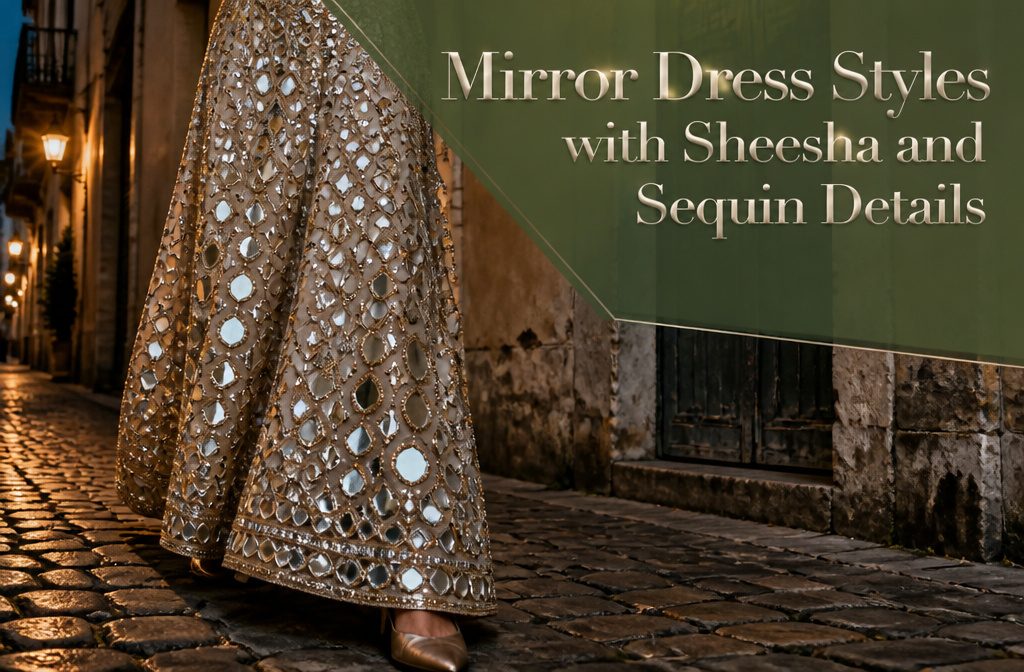
A dress with mirrors uses small pieces of reflective acrylic sewn or glued to fabric, not actual glass.
The technique comes from Indian sheesha embroidery, where artisans have hand-stitched mirrors into cloth for five centuries, though the question of cultural appropriation depends on whether designers credit the tradition and pay fair wages.
Acrylic mirrors can be cut into circles, teardrops or hexagons, and the shape changes how light catches across a room.
What Mirror Dresses Are Made Of
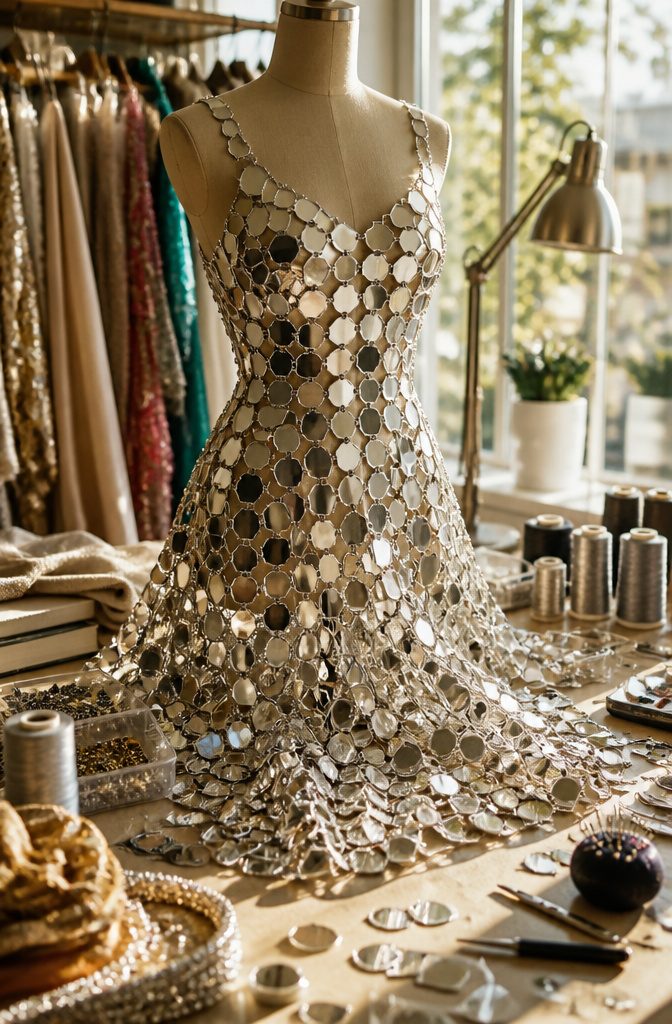
Mirror dresses don’t use actual glass mirrors. The reflective pieces are cut from lightweight acrylic, which gives you the shine without the weight or the risk of shattering.
That makes a difference when you’re moving in one for hours, whether you’re dancing or just standing through a long event.
The acrylic can be cut into different shapes: circles, teardrops, hexagons, or tiny square tiles.
Each shape changes how the light catches and how the finished dress reads from across a room. Round mirrors scatter light more softly, while angular cuts throw sharper flashes.
Designers attach the pieces to fabric using thread or adhesive backing, sometimes layering them densely for full coverage and sometimes spacing them out to let the base fabric show through.
That flexibility is what lets mirror dresses range from subtle shimmer to full disco ball.
The Indian Roots of Sheesha Embroidery

Sheesha embroidery comes from the desert regions of Gujarat and Rajasthan, where artisans have been hand-stitching tiny mirrors into fabric for at least five centuries.
The technique was practical before it was decorative: reflective surfaces were believed to ward off the evil eye, and in regions where metal and glass were expensive, small mirror pieces made precious materials go further.
Each mirror is secured with a framework of buttonhole stitches, then surrounded by chain stitch, satin stitch or herringbone work in silk or cotton thread.
The process is slow and the resulting fabric catches light in a way sequins never quite match.
When Western designers use mirror work on runway pieces or festival wear, the question of cultural appropriation versus appreciation turns on attribution and profit.
A designer who sources sheesha work from Indian artisans, credits the tradition and pays fair wages is working in collaboration.
A brand that copies the technique without acknowledgment, manufactures it cheaply elsewhere and sells it at luxury markup is extracting value from a craft it didn’t develop.
The difference matters to the communities whose labor and knowledge built the tradition in the first place.
Strappy Maxi Dress with Mirrored Circles
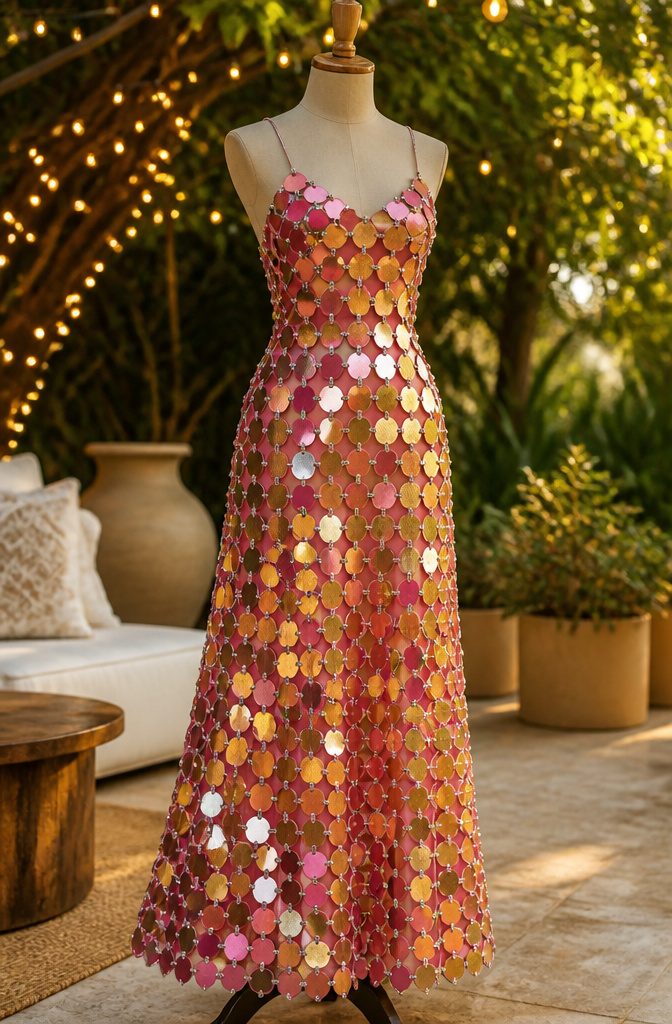
The Tory Burch strappy maxi is the dress that made mirrors everywhere, and if you spend any time on wedding-guest Instagram you’ve seen it.
Mirrored circles in pink and yellow cover the fabric in an all-over pattern, each tiny reflective disk catching light from a different angle.
The silhouette is simple: narrow straps, a fitted bodice, and a full-length skirt that moves. The mirrors do the work.
Brands like Tory Burch and J.Crew are having a heyday with mirrors at the moment, stitching tiny reflective circles into skirts and tops.
— The Cut
If you’re looking for a dress with actual mirror embellishment rather than sequins that mimic the effect, this is the one people reach for first.
The circles sit flat against the fabric, sewn in rather than glued, and the density is high enough that the dress reads as textured from a distance.
Pink leans warmer, yellow pushes brighter, and both versions photograph like they’re lit from within.
Sleeveless Halter Neck Mirror Dress with Mesh Skirt
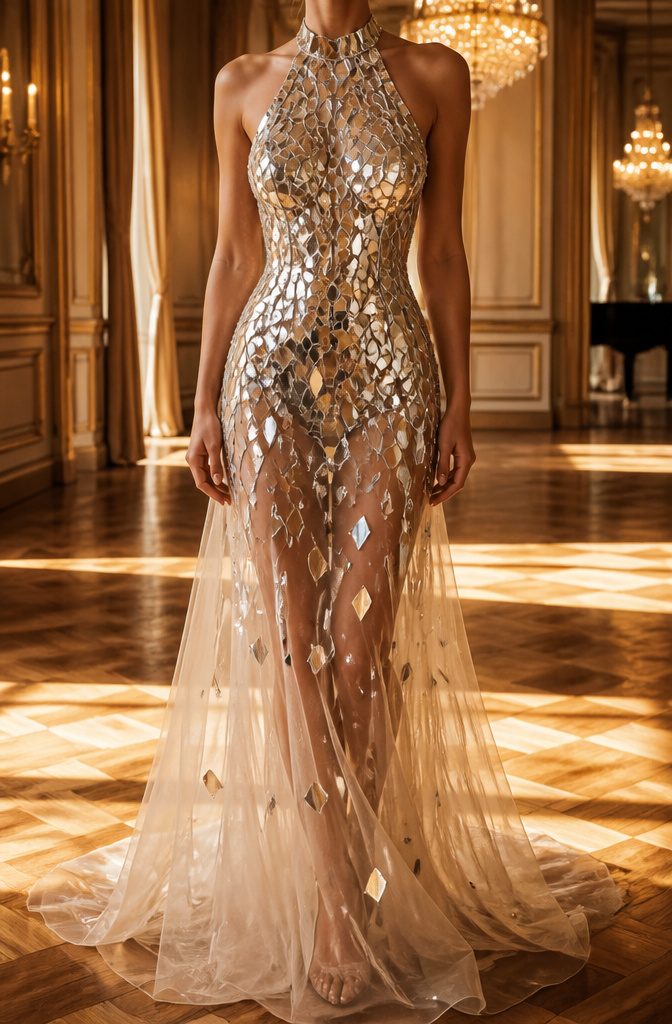
The halter silhouette changes how mirrors sit on the body. A sleeveless halter concentrates embellishment at the neckline and bodice, leaving the shoulders bare and pulling attention straight up to the collarbone.
That matters when you want the sheesha work to read from a distance without making your torso look rigid or heavy.
The halter strap keeps the neckline high, so the mirrors catch light as you turn your head or raise your arms.
Mesh works differently than solid fabric under mirror weight. A fitted bodice holds the sheesha in place, but once the dress opens into a mesh skirt, the mirrors shift from structural to decorative.
You get movement the way you do not with a fully lined column dress. The mesh reads sheer enough to show leg without exposing skin directly, and scattered mirrors inside the panels break up the transparency.
The contrast between the dense, embellished halter and the floating skirt gives the dress a silhouette that does not stop at one note.
One Shoulder Mirror Jacket for Stage Dance
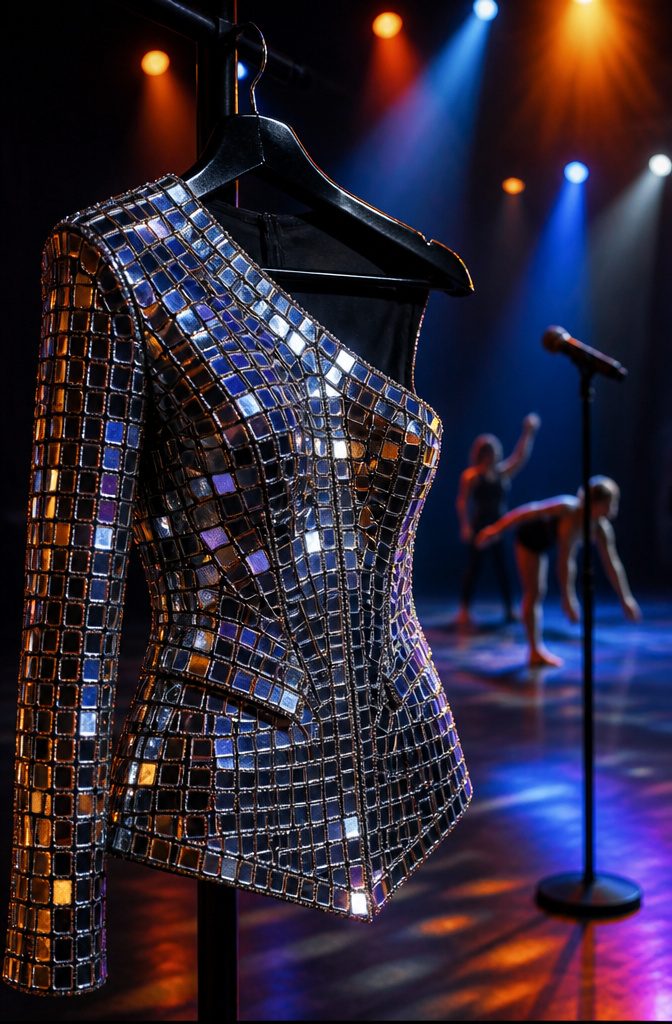
The asymmetric cut gives this jacket an edge that symmetric pieces just can’t match. Stage lighting hits the mirrors at different angles as you move, which means the reflections shift with every turn or step.
That constant play of light reads from the back of the room, exactly what you need when performing under spotlights or colored washes.
The single shoulder strap keeps the opposite arm completely free for movement. Dancers working with large gestures or lifts won’t fight fabric, and the jacket stays put without riding up or shifting mid-routine.
The mirrors themselves sit along the shoulder line and across the torso in a pattern that follows the body’s natural lines, so they catch light whether you’re facing front or angled to the side.
Silver Dress with Tiny Mirror Tiles
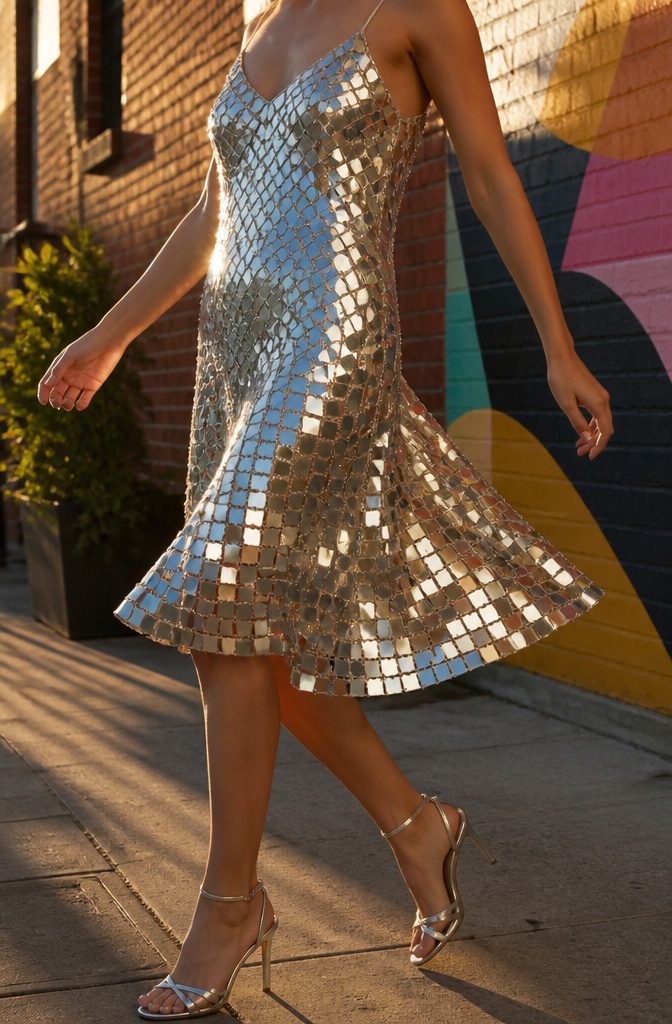
A silver dress covered in small reflective acrylic tiles creates an all-over shimmer that registers as pure bling the moment light hits it.
These tiles, usually reflective acrylic rather than actual glass mirror, are cut small enough to be drilled at the corners and sewn in place with needle and thread.
The result is a surface that moves and catches light with every step, far more dynamic than sequins alone.
The tiny tile size is what makes the difference. Where larger mirror pieces sit as individual accents, small tiles can cover an entire garment in a continuous reflective surface.
The smaller the piece, the lighter the finished dress and the easier it is to attach with fabric glue if you skip the drilling step altogether.
When they first appeared a couple of years ago, these dresses were mainly silver and long, but now you’ll find creative patterns, multiple colors, and styles that go well past the formal gown category.
Off-the-Shoulder Sweetheart Neckline Silver Mirror Gown
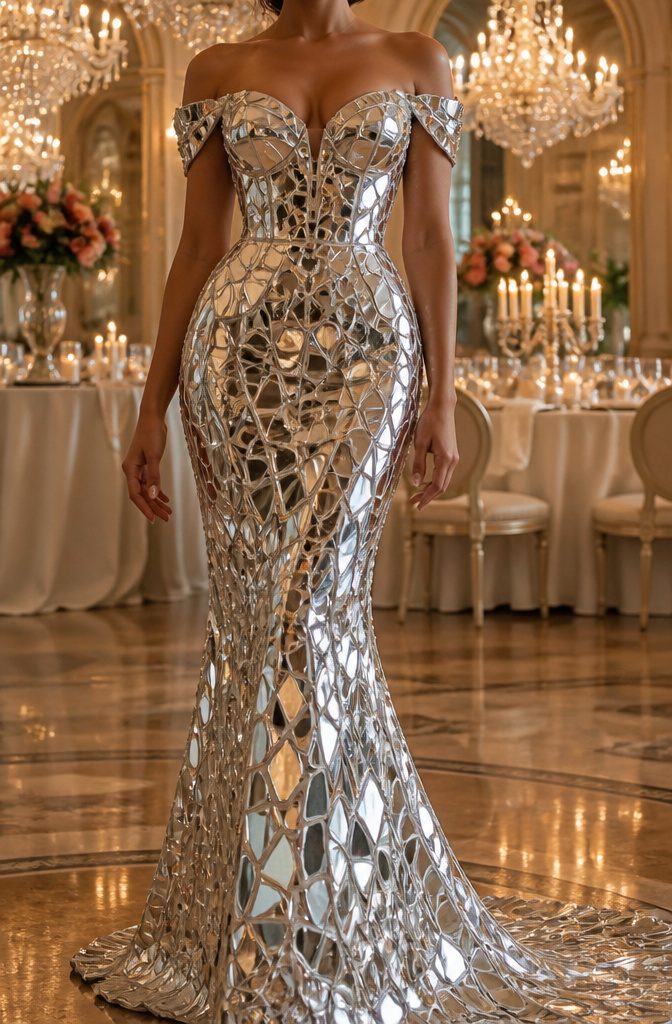
The off-the-shoulder sleeve keeps this gown from reading as too formal for younger guests while preserving the structure a floor-length silhouette needs.
The sweetheart neckline balances the covered shoulder line and creates a focal point that pulls the eye toward the face rather than letting the mirror embellishments dominate.
Silver mirrors catch light from every angle, so the shape underneath has to hold its own or the whole dress reads as costume rather than eveningwear.
I’d choose this cut for black-tie weddings where the dress code skews traditional but the crowd skews younger. The off-the-shoulder detail softens the formality just enough to work in a ballroom without looking out of place next to strapless gowns.
The sweetheart neckline also means you can wear a statement necklace if the mirror detail feels too minimal on its own, though most versions layer enough embellishment that jewelry becomes optional rather than necessary.
Mirror Cocktail Mini Dress with Cross Straps
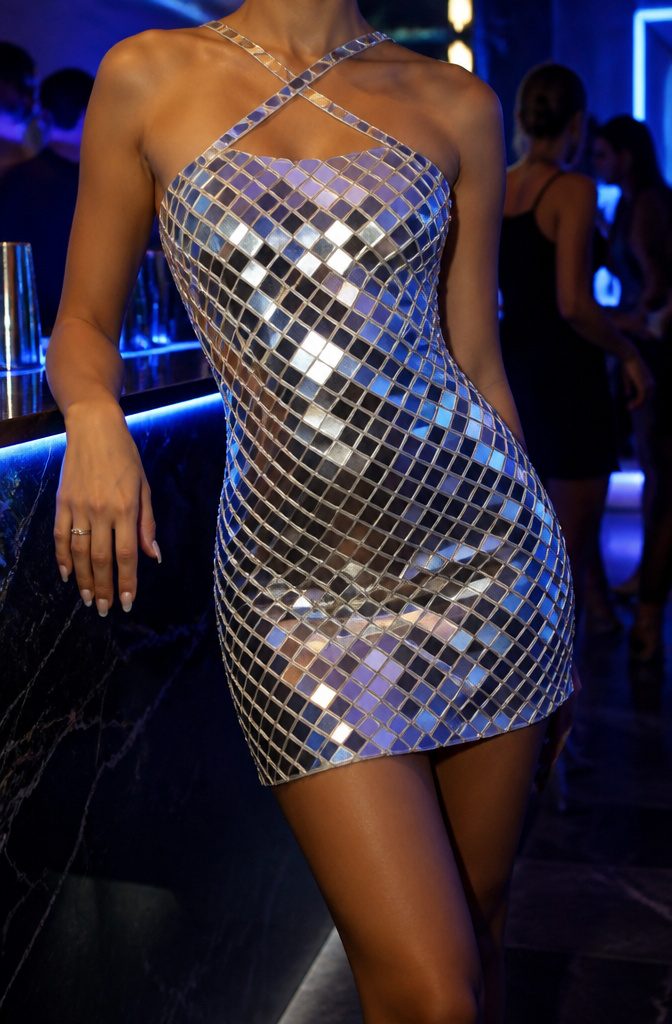
The cross-strap mini puts mirror work into party territory rather than ceremony.
The straps themselves are usually thin and multiply quickly: two crossing at the back, sometimes three, occasionally lacing all the way from neckline to hem in a way that reads more athletic than formal.
That construction keeps the fit snug without relying on built-in boning, which makes the whole piece lighter and easier to move in when you’re on your feet for hours.
Mini length here means anywhere from mid-thigh to just above the knee, and the mirror tiles tend to sit densest across the bodice, thinning out or stopping entirely before the hemline.
The result catches light where it counts without turning the whole dress into a disco ball.
You’ll see this silhouette most often in nightlife contexts: club nights, rooftop parties, New Year’s Eve, anywhere the dress code leans toward bold over polished.
Long Mirror Silver Gown with Open Back
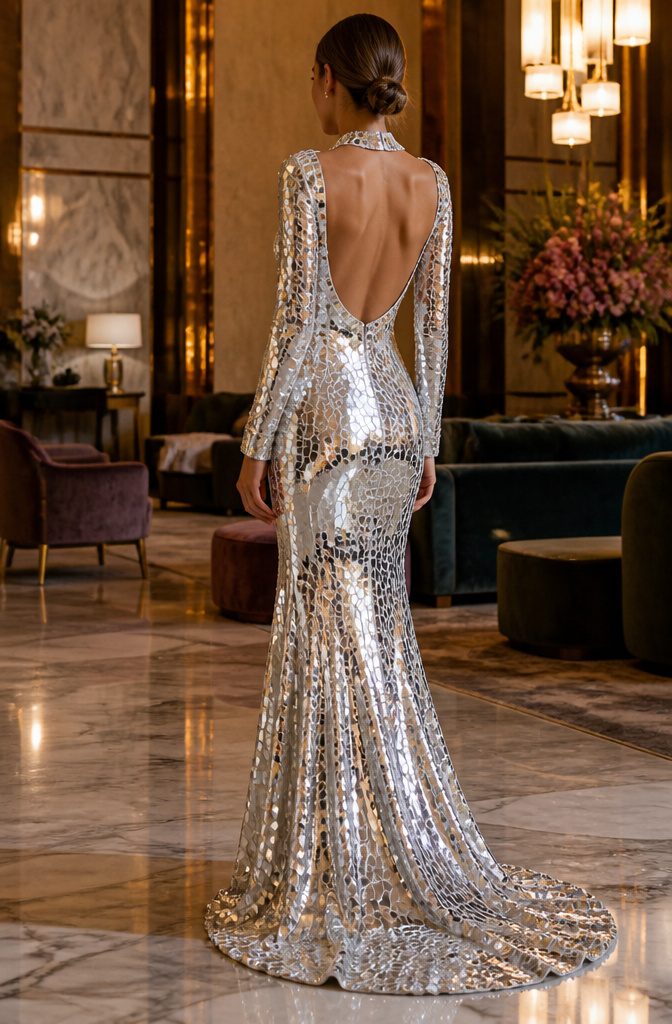
The long sleeves give you coverage without losing the impact of an open back, and that balance matters when the dress already carries as much reflective detail as silver mirror embroidery typically does.
The sleeves draw attention upward and forward, so the open back reads as intentional design rather than exposure for its own sake. You get drama without the feeling that the dress is working too hard.
Mirror placement on this style tends to concentrate along the neckline, cuffs, and the edges of the back opening itself.
The embroidery frames the open section rather than scattering across the entire bodice, which keeps the focus where the structure wants it.
The result is a gown that photographs well from every angle but still makes sense in person, where too much reflective surface can read as costume rather than evening wear.
Silver works because it stays cool-toned and doesn’t compete with the mirrors themselves. Gold embroidery on this silhouette can tip into overwrought; silver keeps the gown sharp.
Handmade Sequin Disco Mirror Bodysuit
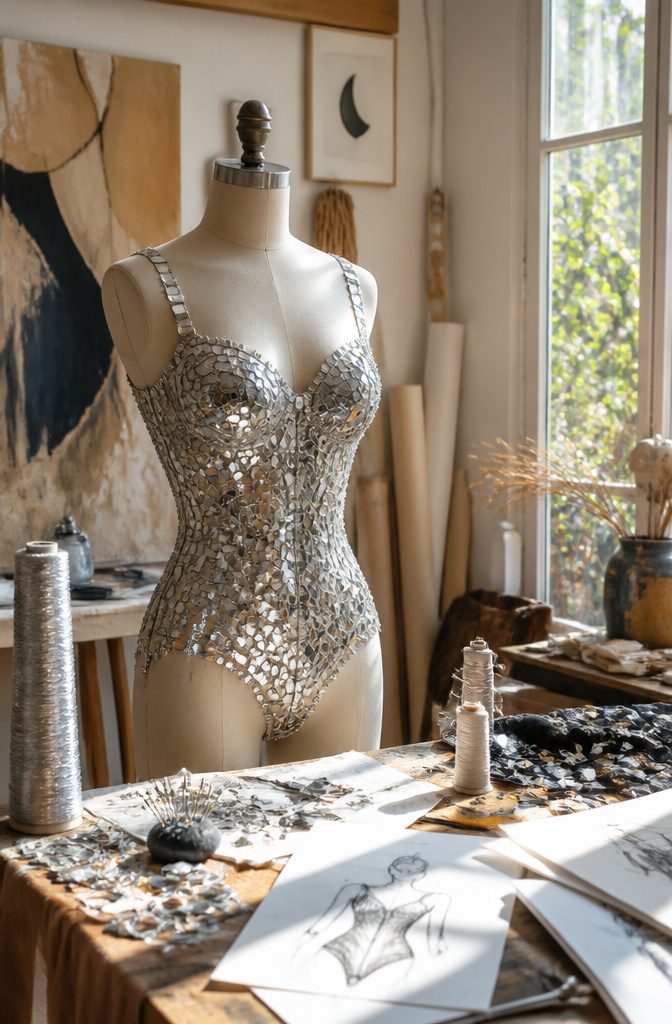
A handmade sequin and mirror bodysuit lands somewhere between costume and couture.
The construction matters here more than it does for most pieces, because hand-stitched mirrors and sequins lie flatter and catch light differently than the machine-applied versions you find in fast fashion.
Each reflective element gets sewn on individually, so the pattern can follow the body’s curves instead of fighting them.
The disco styling keeps the silhouette simple. A bodysuit gives you full coverage without bulk, and the mirrors do all the work.
You see this most clearly at the neckline and along the seams, where handwork lets the embellishment wrap cleanly around edges that would pucker or gap with glued-on sequins.
You’ll pay more and wait longer. Handmade pieces take longer to produce and cost more, but they also hold up better under movement and don’t shed sequins after a few wears.
Silver Mirror Disco One-Piece Bodysuit
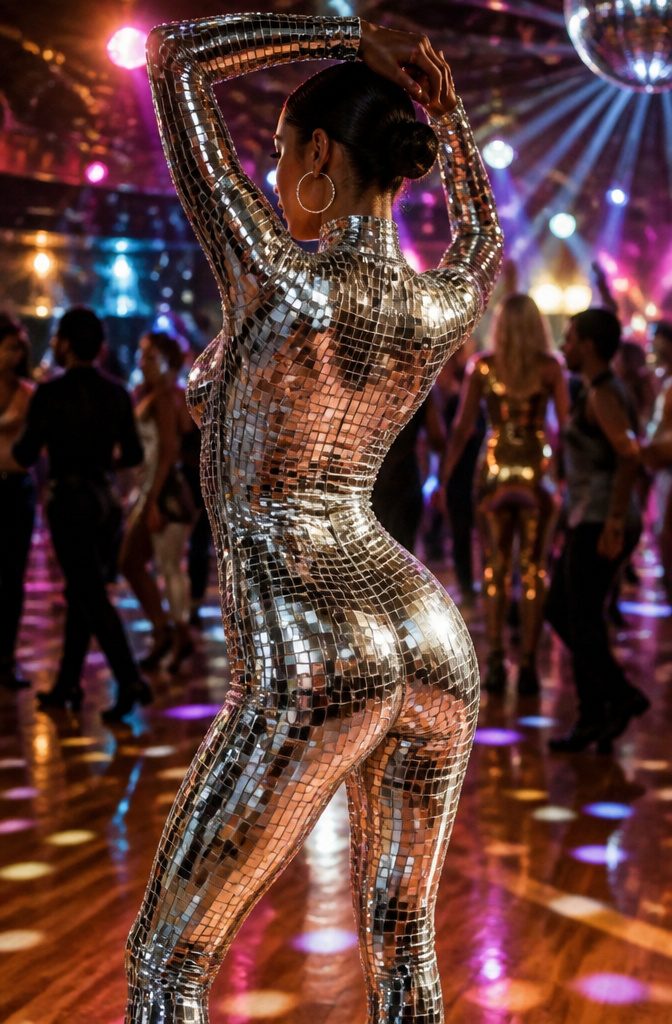
The all-over silver mirror bodysuit built for disco and dance floors covers you from shoulders to inseam in reflective tiles, which means it reads more like athletic performance gear than a dress silhouette.
A dress gives you hem movement and a defined waist, but the bodysuit holds everything close and stays put through spins and drops.
That construction keeps mirrors from catching on fabric or lifting mid-routine, which matters when stage lighting hits every angle.
The one-piece fit works for dancers who need full mobility without adjusting a hemline or worrying about a skirt riding up.
You lose the flow of a maxi or the drama of a gown’s open back, but you gain security and a clean line from neck to ankle.
If your event involves choreography or extended movement rather than standing and mingling, the bodysuit holds up better than any dress cut.
Short Mirrored Dress with Slit Sleeves and High Collar
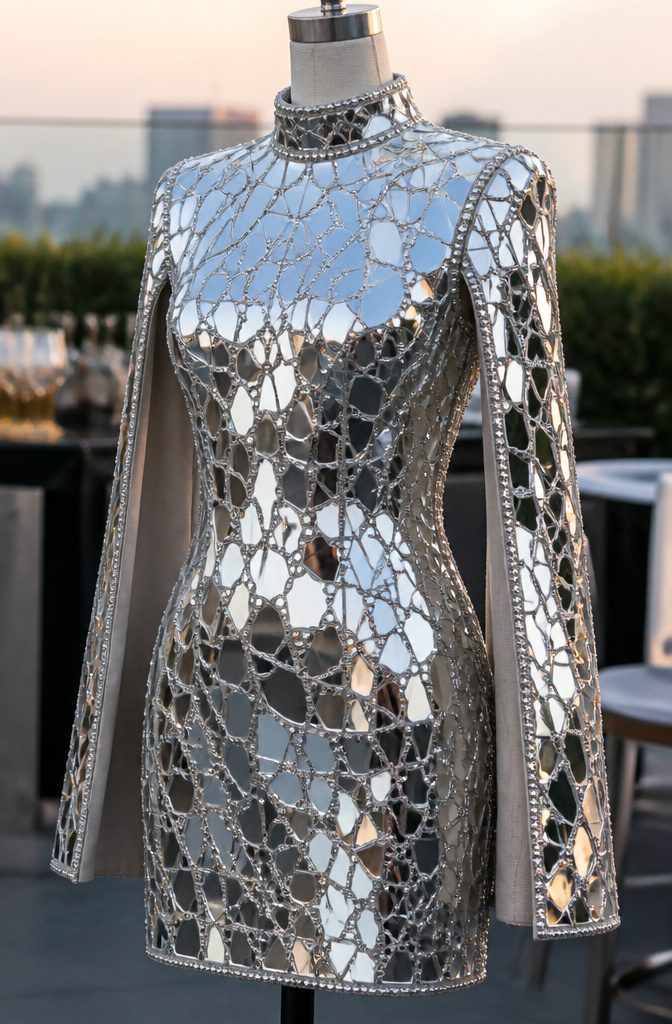
The high collar sits close to the neck and holds the bodice in place while slit sleeves let you move without the fabric gripping your upper arms.
That structure matters when mirrors catch every shift in posture. The collar frames the face and keeps the neckline covered, so the shine stays below the collarbone rather than competing with your jewelry or makeup.
Slit sleeves open along the shoulder seam or the outer edge of the arm, which means the fabric drapes rather than clings.
I like that detail on a short dress because it keeps the silhouette balanced: the hemline ends above the knee, and the sleeves add movement without bulk.
The mirrors themselves are usually clustered at the bodice or along the neckline, where they reflect light when you turn or lift your arms.
Sleeveless Spaghetti Strap Mirror Bodysuit Robe
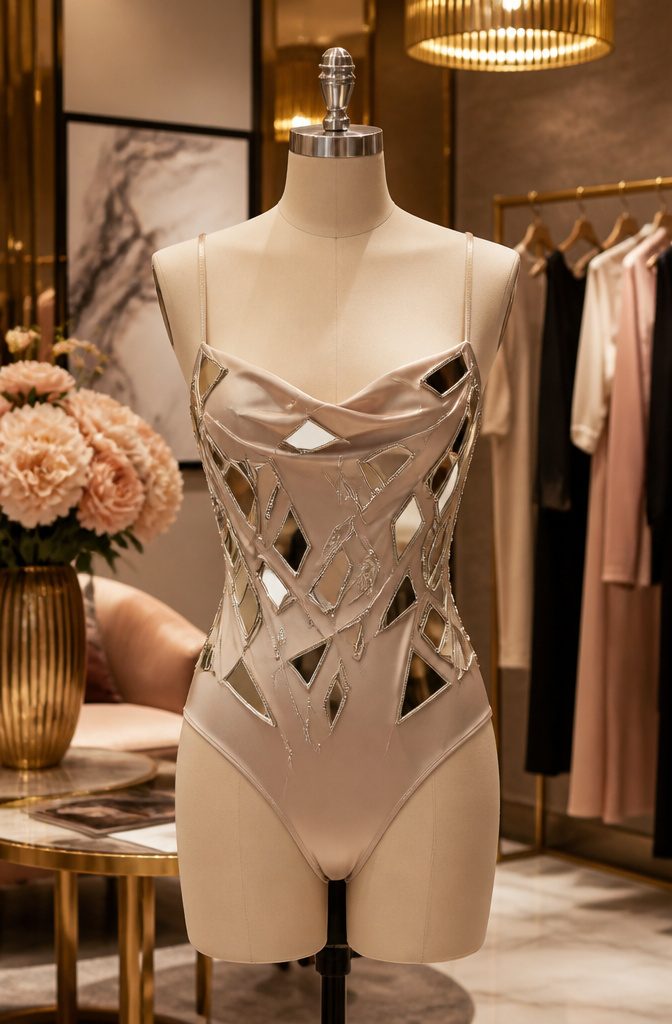
The bodysuit robe is built for layers: you wear it over a separate bodysuit rather than as one piece.
The spaghetti straps sit light on the shoulders, and the robe portion wraps or hangs open like a coat you chose not to fasten.
Mirror details catch the light along the neckline or down the front edges, so the reflective work frames the silhouette without covering the whole surface.
This construction gives you two pieces that move independently. The bodysuit underneath keeps coverage predictable, and the robe layer adds drama when you want it without committing to full sequin or mirror encrustation across your torso.
You can pull the robe closed for a more modest line or leave it open to show the bodysuit beneath.
The spaghetti straps make the whole thing feel delicate rather than structural, so it reads as evening wear even though the two-layer build offers more flexibility than a standard dress.
Mirror Warrior Princess Puff Shoulder Bodysuit
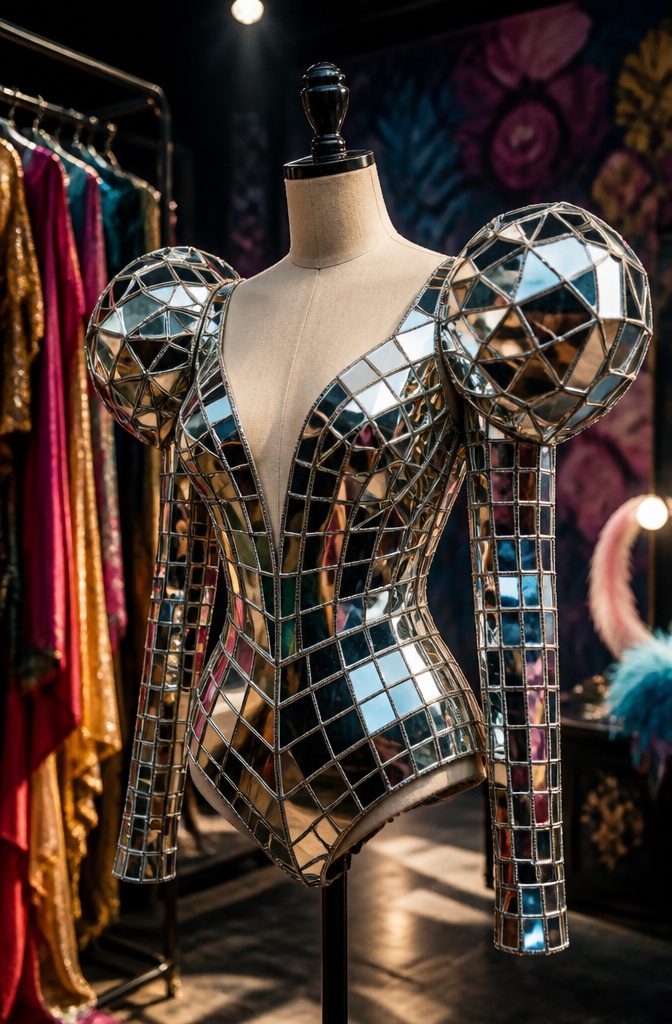
The puff shoulder bodysuit answers the question almost no one asks until they see it: what if festival armor was wearable?
This is a one-piece built around theatrical excess, with structured shoulders that balloon out in sharp angles and mirror work dense enough to catch stage light from twenty feet back.
The silhouette reads as costume before clothing, and that is entirely the point.
The warrior princess framing makes sense when you consider the proportions. The shoulders carry the drama, balanced by a fitted torso that keeps the piece from collapsing into pure costume.
Mirror tiles or sequined panels follow the curves of the bodysuit rather than lying flat, which gives the piece dimension under movement. It works for performance, cosplay, or the kind of event where blending in would be the actual mistake.
Short Cocktail Outfits Encrusted in Mirror Sequins
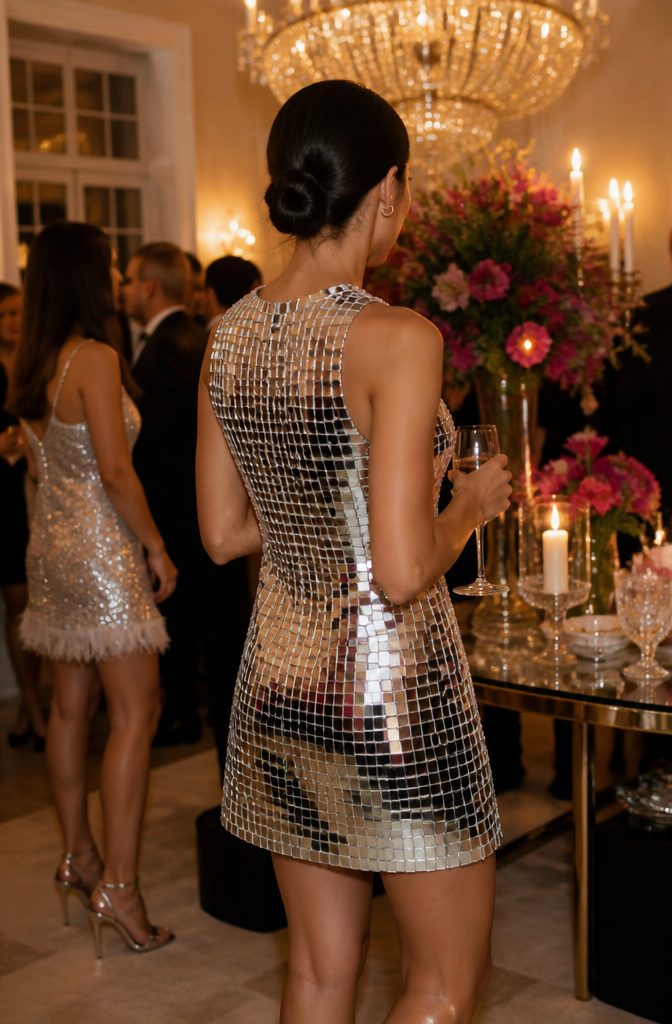
Short cocktail dresses covered entirely in mirror sequins sit somewhere between party staple and costume piece, and how wearable they actually are depends on whether the sequins are encrusted or scattered.
Encrusted placement means the reflective discs are packed edge to edge across the bodice, sleeves and skirt, leaving almost no fabric visible beneath.
The result catches light from every angle, which makes the dress read as fully metallic rather than just embellished.
Scattered mirror placement, by contrast, leaves gaps between each sequin, so the base fabric shows through and the overall effect stays softer.
The encrusted technique delivers more drama, but it also adds weight and stiffness, especially if the mirrors are glass rather than acrylic.
You feel that in the hemline and around the armholes, and it matters most in shorter styles where movement and fit have less room to forgive bulk.
Long Sleeves High Neck Mirror Sequin Dresses
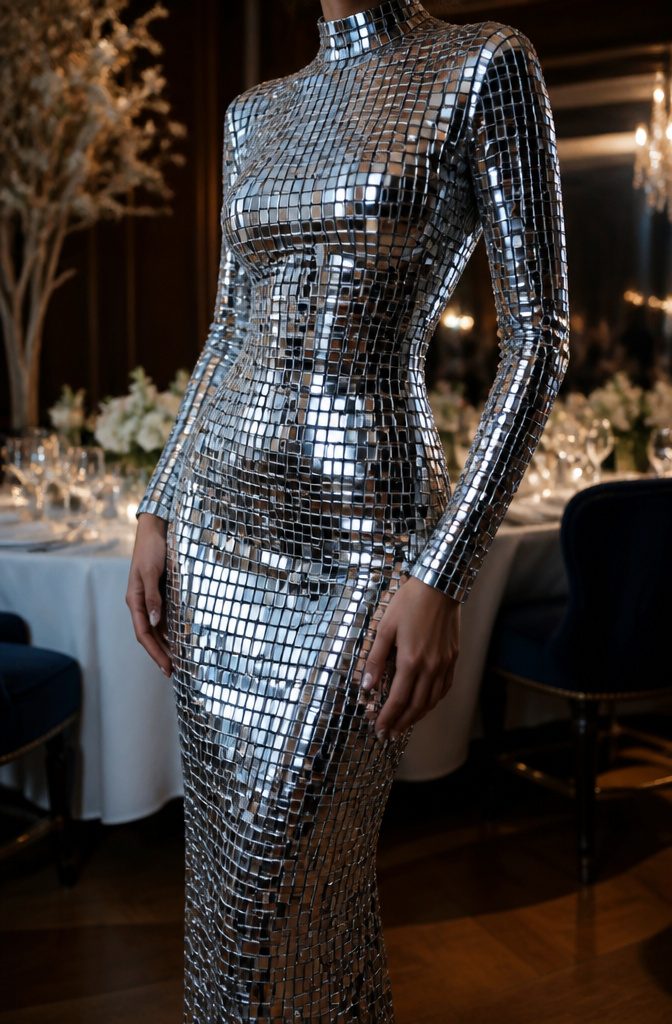
A high neckline and long sleeves usually shift the focus away from embellishment, but mirror sequins reverse that expectation.
The coverage becomes the canvas. You get drama without showing much skin, and the reflective surface does all the work a plunging neckline or open back would normally handle.
The silhouette reads formal enough for winter galas or religious ceremonies where bare shoulders would feel out of place. Mirror work catches low light better than flat sequins, so even indoor venues with dim chandeliers give you plenty of movement.
The neckline sits close to the throat, often with a mandarin or mock-neck finish, and the sleeves run to the wrist.
That structure holds the mirror tiles in place without gaps or bunching, which matters when the dress relies on a continuous reflective field rather than scattered accents.
Fitted styles work better than loose ones. A body-conscious cut keeps the mirrors flat against your frame, so they catch light at consistent angles as you move.
Silver Mirror Crystal Corset Bustier
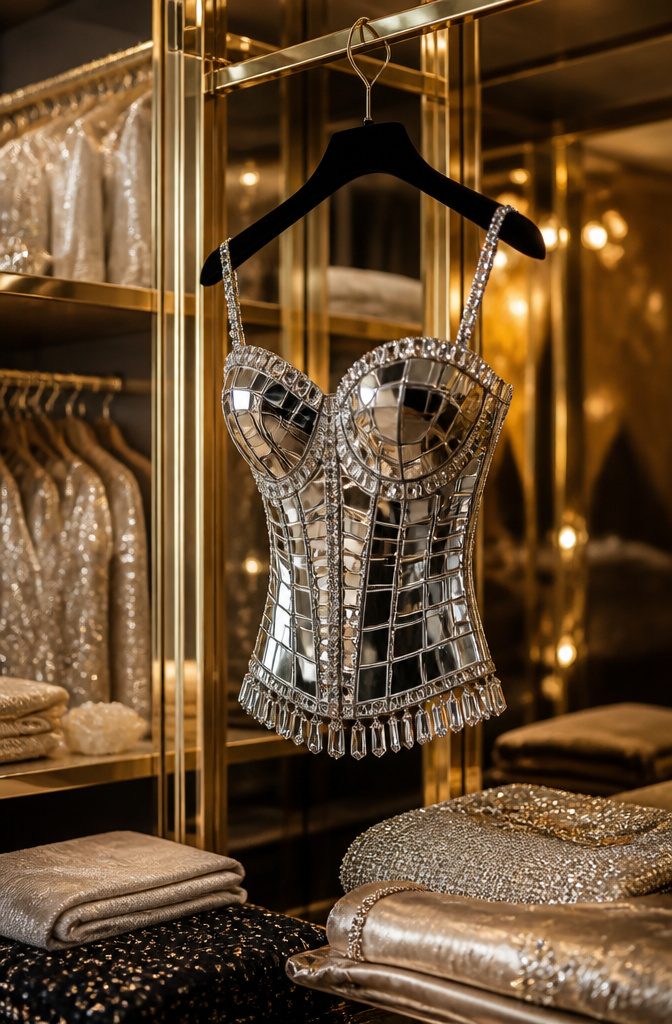
The corset base holds the embellishment where a standard bodice would sag under the weight. Silver mirrors anchor the design, arranged in tight rows or radiating patterns that catch light from every angle.
Crystals and rhinestones fill the gaps between mirrors, adding depth without fighting for attention. Beads outline the seams or trace the boning channels, and the result is a surface that reads as intentional density rather than random sparkle.
The structure matters as much as the decoration. A true corset shape uses steel or spiral boning to distribute weight across the torso, which means the mirrors stay flat against the body instead of pulling fabric out of shape.
That rigidity also sharpens your silhouette in a way a bustier without boning can’t match. Mobility suffers: you sit carefully, and bending at the waist feels more like tilting a board.
Where Mirror Dresses Work for Performance Wear
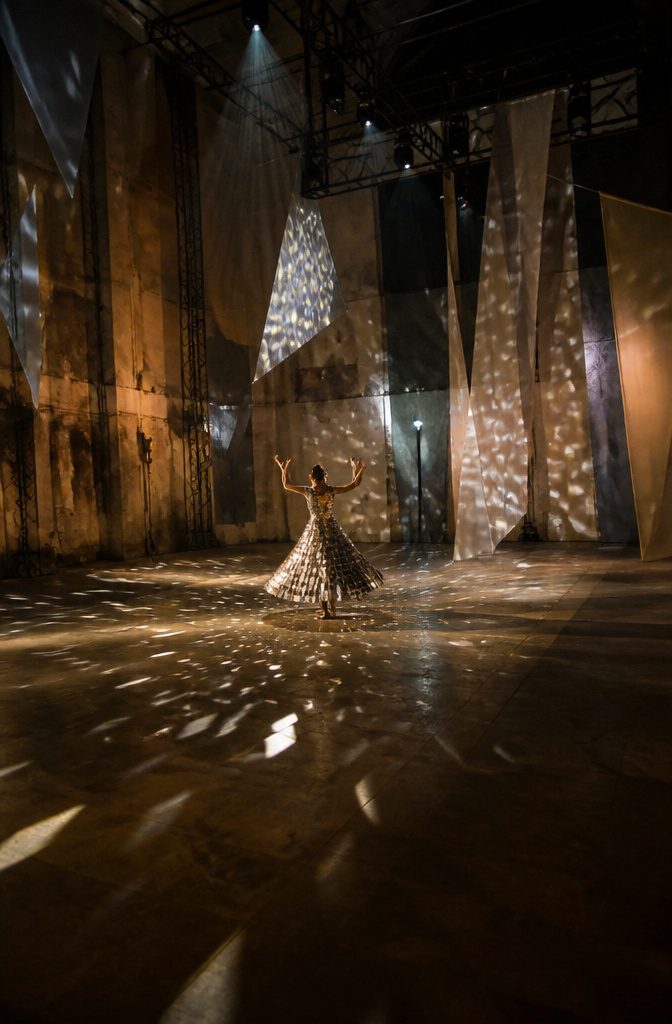
Performance lighting turns every piece of reflective surface into a spotlight of its own, and that is exactly why mirror dresses dominate dance competitions and stage shows.
The small glass or mirrored sequins catch beams from every angle, throwing light back toward the audience in sharp, moving bursts that make a dancer visible even in a crowded ensemble.
A static costume might disappear under stage wash, but mirrors guarantee you read as kinetic and bright from the back row.
Dance competitions reward that kind of visibility. Judges track multiple performers at once, and a mirrored bodice or skirt panel gives you an edge in a lineup of twenty routines set to identical lighting cues.
Stage shows lean on the same principle: a performer in mirrors becomes a moving point of light, pulling focus without a single follow spot.
The effect is dramatic because it is genuinely optical, not just decorative, and that makes mirror work a fixture in performance costumes where being seen is half the score.
Frequently Asked Questions
What is a mirror dress?
A mirror dress is a garment covered in small reflective pieces, typically cut from lightweight acrylic rather than actual glass.
The reflective surfaces catch light from different angles as you move, creating a shimmering effect that ranges from subtle sparkle to full disco ball depending on how densely the pieces are placed.
Designers use various shapes like circles, teardrops, hexagons or square tiles, attaching them to fabric with thread or adhesive backing.
Where did the trend of mirror dresses originate?
Mirror work in fashion comes from the sheesha embroidery tradition of Gujarat and Rajasthan in India, where artisans have been hand-stitching tiny mirrors into fabric for at least five centuries.
The technique was originally practical, as reflective surfaces were believed to ward off the evil eye in regions where metal and glass were expensive.
Each mirror is secured with buttonhole stitches and surrounded by decorative threadwork, a slow process that creates a light-catching effect sequins can’t replicate.
What materials are used in mirror dresses?
Mirror dresses use lightweight acrylic cut into reflective pieces rather than actual glass mirrors. This material gives you the shine without the weight or shattering risk, which matters when you’re wearing the dress for hours.
The acrylic can be cut into different shapes like circles, teardrops, hexagons or tiny square tiles, each changing how light catches and how the dress reads from a distance.
What is mirror work embroidery called?
Mirror work embroidery is called sheesha, a technique from the desert regions of Gujarat and Rajasthan in India.
Artisans secure each small mirror with a framework of buttonhole stitches, then surround it with chain stitch, satin stitch or herringbone work in silk or cotton thread.
The process has been practiced for at least five centuries and creates a reflective surface that catches light differently than sequins.